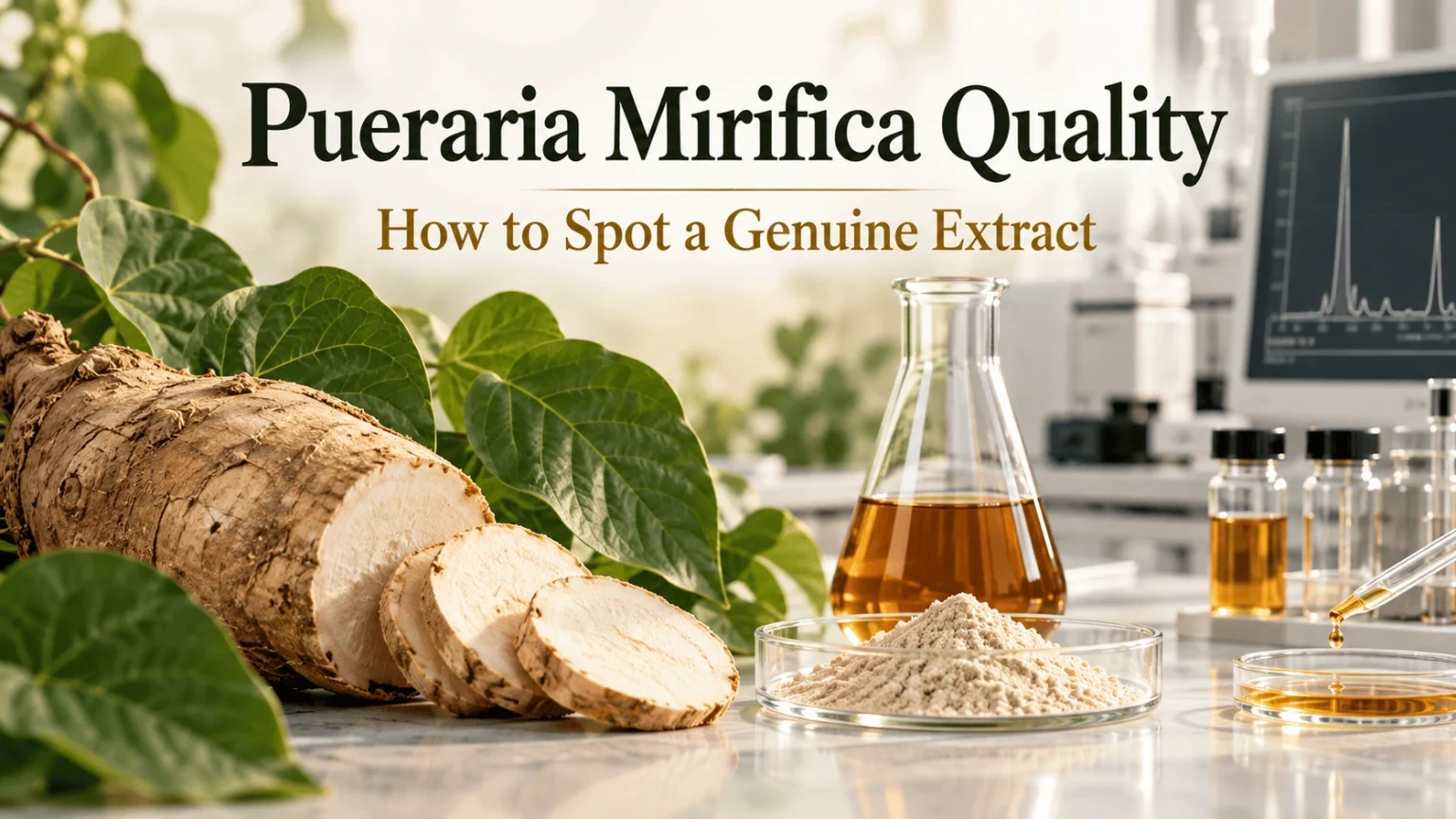
Why Pueraria Mirifica quality varies so much
Because the plant is geographically limited and easy to confuse with its relatives, quality and authenticity are genuine concerns in this category. Three factors make it more prone to inconsistency than most botanicals:
It closely resembles its relatives
Pueraria Mirifica can be confused with — or diluted by — other Pueraria species, including kudzu (Pueraria lobata), so the full species name on a label matters.
Active compound levels vary naturally
When four cultivars were grown in the same field, their roots showed significantly different isoflavone contents, and the same cultivar varied by harvest season. Two roots can look identical while differing meaningfully in composition.
Research standardization is still evolving
A systematic review of the clinical trials noted that the active ingredients and sources of the extracts used were not defined, and named the lack of standardization as a key limitation. The same inconsistency shows up between commercial products.
None of this means the ingredient is unreliable. It means sourcing and testing matter more here than in many other categories.
From farm to formula
Much of the Pueraria Mirifica sold today comes from cultivated rather than wild plants. Done well, cultivation is a quality advantage rather than a compromise — it allows for:
- Cultivar tracking — a grower knows which strain, and therefore roughly what chemical profile, they are working with.
- Controlled harvest timing — compound content changes with season.
- Soil and growing-condition consistency — reducing the batch-to-batch variability seen in wild-harvested material.
- Traceability — a brand can document where and how a given batch was grown.
When evaluating a supplier or a finished product, named cultivar and growing-region information is a meaningfully positive signal.
Standardization: the most useful quality signal
The clearest, most checkable quality marker for any Pueraria Mirifica product is standardization — the extract has been tested to contain a specific, stated amount of its key compounds. Researchers have developed HPLC methods for exactly this purpose, and more recently an ELISA test that correlates closely with HPLC, with the stated goal that the content of these compounds in commercial products should be specified. Two markers matter most:
- Primary marker · Miroestrol
- The most potent phytoestrogen of this plant and characteristic of it — a strong indicator that a product is genuine Pueraria Mirifica rather than a diluted or substituted ingredient.
- Secondary marker · Total isoflavone content
- Puerarin, daidzin, daidzein, genistin and genistein, measured by HPLC — the same compounds used to compare cultivars and harvest seasons in field research.
A product or raw material that states these numbers — ideally with reference to lab testing — is giving you something concrete to evaluate.
Testing for contaminants, not just potency
Standardization tells you how much of the active compounds a product contains. It does not tell you whether the material is clean. Because this is a root crop grown in soil, contaminant testing is a separate and equally important dimension.
Reputable suppliers test raw material for pesticide residue, heavy metals and microbial contamination before it enters the supply chain — particularly for material destined for capsules, powders or liquid extracts, where the ingredient is consumed directly rather than diluted into a larger formula. For B2B buyers and formulators, a certificate of analysis is a reasonable request.
You do not need a chemistry background to shop well in this category — you need to know which two or three questions to ask.
A practical checklist
If a listing cannot answer these points, that is useful information in itself.
Core Pueraria Care
Breast Capsules 60 capsules

Core Pueraria Care
Breast Cream 100 g
Key takeaways
- Quality issues in this category come down to species confusion, natural variation in compound content and inconsistent standardization — not the ingredient itself being unreliable.
- Cultivated, traceable sourcing is a quality advantage when it comes with cultivar and origin documentation.
- Compound content differs between cultivars and harvest seasons, so two similar-looking roots are not automatically equivalent.
- Stated miroestrol and total isoflavone content, tested by HPLC or a validated equivalent, are the most concrete quality signals available to buyers.
Frequently asked questions
What’s the single best sign of a quality product?
A stated standardization level for miroestrol content, alongside correct species naming and disclosed origin. Vague claims like “high potency” without numbers are a weaker signal.
Is wild-harvested better than cultivated?
Not necessarily. Cultivation with cultivar tracking and controlled harvest timing can offer more consistent material, since compound content varies by cultivar and season.
How can I tell if a product is diluted or mislabeled?
Look for the full species name, a stated extract standardization and named origin. Products that only say “Pueraria” or “kwao krua” without further detail carry a higher risk of being a different species.
How are miroestrol and deoxymiroestrol measured?
HPLC is the established laboratory method. An ELISA test has also been developed that measures both compounds together and correlates closely with HPLC results.
Sources
- Cherdshewasart W, Sriwatcharakul S. Major isoflavonoid contents of the 1-year-cultivated phytoestrogen-rich herb, Pueraria mirifica. Biosci Biotechnol Biochem. 2007;71(10):2527–2533. PubMed
- Kongkaew C, et al. Efficacy and safety of Pueraria candollei var. mirifica for menopausal women: a systematic review of clinical trials and the way forward. J Ethnopharmacol. 2018;216:162–174. PubMed
- Shimokawa S, et al. Quantitative analysis of miroestrol and kwakhurin for standardisation of Thai miracle herb “Kwao Keur” (Pueraria mirifica). Nat Prod Res. 2013;27(4-5):371–378. PubMed
- Yusakul G, et al. Enzyme linked immunosorbent assay for total potent estrogenic miroestrol and deoxymiroestrol of Pueraria candollei. J Nat Med. 2018;72(3):641–650. PubMed
- Zeng H, et al. Pueraria mirifica: a critical review of the ethnobotany, phytochemistry, pharmacology and challenges in standardization and safety. Front Pharmacol. 2026;17:1820644. PubMed
These statements have not been evaluated by the Food and Drug Administration. This product is not intended to diagnose, treat, cure or prevent any disease.
Herbal supplements are not a substitute for medical advice. Talk to a healthcare professional before use if you are pregnant, breastfeeding, taking medication or being treated for a medical condition.
Published by
Pueraria Mirifica™