
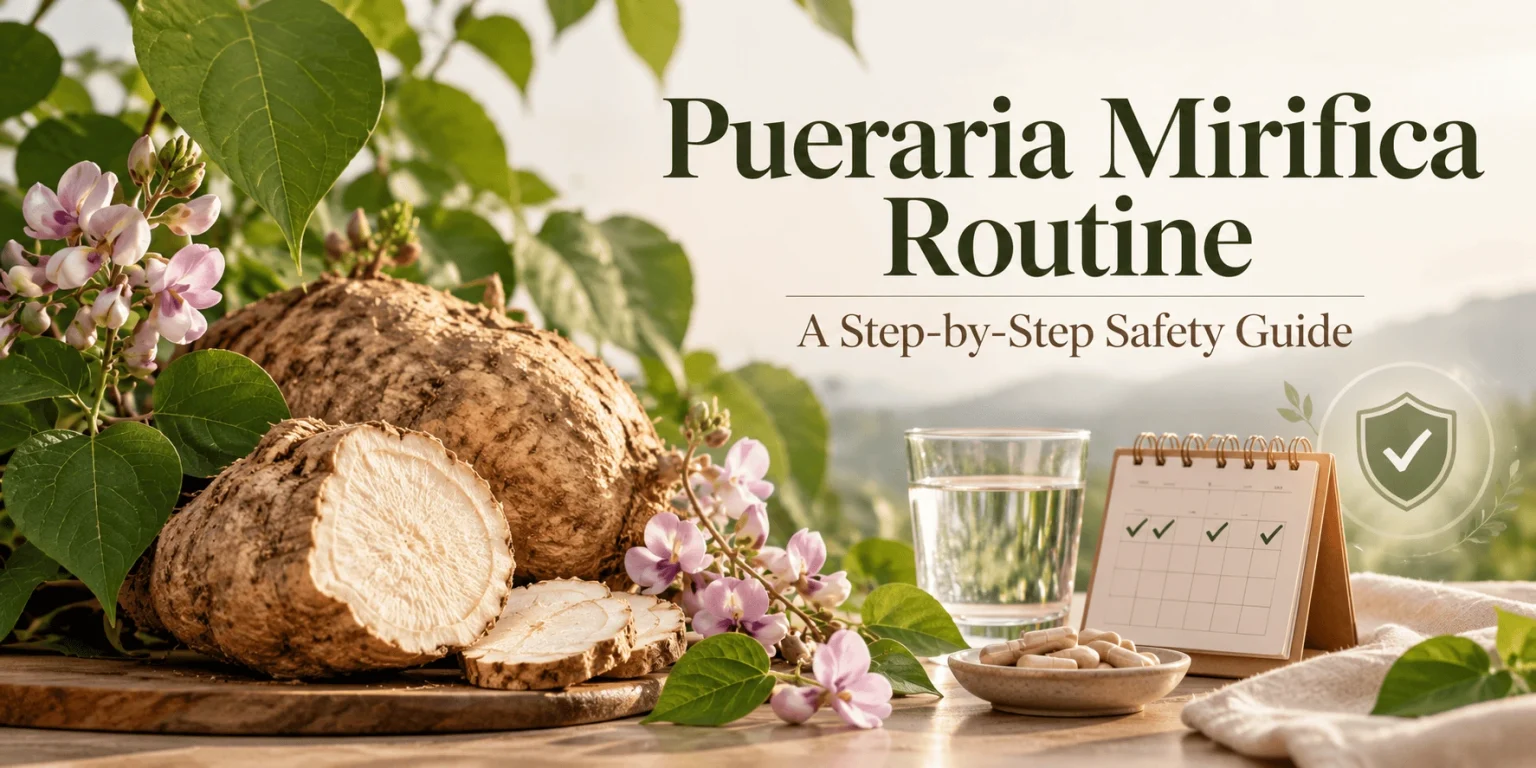
Start slow: five steps for a Pueraria Mirifica routine
A responsible routine does not try to do everything at once.
Choose one starting product
If you are new to the ingredient, pick a single format — commonly a capsule or one topical product — rather than starting with a full multi-step routine. The format guide can help you decide where to start.
Follow the labeled amount
Clinical research on oral Pueraria Mirifica has used defined, moderate daily doses under study conditions — one placebo-controlled trial, for example, gave 20 to 50 mg a day for 24 weeks. There is no good evidence that exceeding a product’s labeled amount improves results.
Give it time, and pay attention
Allow a new product a few weeks before judging results, and pay attention to how your skin or body responds in the meantime — not just at the end.
Add one product at a time
If you want to combine an oral supplement with a topical, introduce them a few weeks apart rather than starting everything on day one. It makes the cause of any reaction far easier to identify.
Reassess periodically
Revisit whether a product is still the right fit for your goals every few months, rather than continuing indefinitely on autopilot.
Core Pueraria Care
Breast Capsules 60 capsules

Core Pueraria Care
Breast Cream 100 g
What the safety research says
The safety base is real, if still developing. Two findings are worth understanding:
- Topical use · animal research
- A 28-day study of topical vaginal application in postmenopausal macaques reported local tissue improvements with no detected systemic hormonal side effects — a relevant data point.
- Reproductive & hormonal · animal research
- Long-term oral studies in mice found no changes to the reproductive axis at the lower dose tested, while the higher dose affected estrous cycles and mating efficiency in females. Dose matters.
The research calls for thoughtful, moderate use of a well-sourced, properly labeled product — and a good reason not to treat it as risk-free simply because it is a plant.
Who should avoid it, or ask a doctor first
Possible side effects
In the published clinical trials, adverse effects were generally mild, and one 24-week placebo-controlled trial reported mild effects in both the Pueraria Mirifica and the placebo groups. As with any product that has hormone-like activity, any new or persistent symptom after starting a product is worth discussing with a healthcare provider, and is a reasonable reason to pause use.
If you experience a more significant reaction — unusual pain, a skin reaction that does not resolve, or any symptom that concerns you — discontinue use and consult a healthcare professional.
A note on dosage
You may see specific milligram ranges referenced in older research or product marketing. Because standardization, extract strength and individual health circumstances vary so much across products, this guide intentionally does not recommend a dose. The right amount for you is the amount stated on your specific product’s label, and any adjustment to that should be made with a healthcare provider — not by comparing numbers across brands or studies, which are rarely standardized the same way.
Setting realistic expectations
It is not a fast-acting product, and it will not work identically for every person. Results with any skin, hair or wellness routine are gradual, individual, and best judged over weeks rather than days.
Key takeaways
- Build a routine gradually: one product at a time, at the labeled amount, with time to observe how you respond.
- Pregnant or breastfeeding women, and anyone with a hormone-sensitive condition or on hormonal medication, should consult a healthcare provider before use.
- Adverse effects in published trials were generally mild; discontinue and seek medical advice for anything significant or persistent.
- Long-term human safety research is still developing — a reason for thoughtful use of well-sourced products.
- There is no universal “correct” dose across brands; always follow your specific product’s label.
Frequently asked questions
Is it safe to use Pueraria Mirifica long term?
Safety research exists in animal models and in human trials of up to about six months, but long-term human safety data are still limited. Periodic reassessment and healthcare guidance for ongoing use are sensible practices.
Can I use more than the labeled amount to see faster results?
This is not recommended. There is no reliable evidence that exceeding the labeled amount improves outcomes, and animal research shows that effects on the reproductive system depend on dose.
What side effects should I watch for?
Published trials reported generally mild adverse effects. Pause use and consult a healthcare provider if you notice any new, significant or persistent symptom.
Who should not use Pueraria Mirifica?
Pregnant or breastfeeding women, anyone with a hormone-sensitive health condition, and anyone taking hormonal medication should speak with a healthcare provider before use. It is also not recommended for anyone under 18.
Sources
- Jaroenporn S, et al. Effects of Pueraria mirifica, an herb containing phytoestrogens, on reproductive organs and fertility of adult male mice. Endocrine. 2006;30(1):93–101. PubMed
- Jaroenporn S, et al. Assessment of fertility and reproductive toxicity in adult female mice after long-term exposure to Pueraria mirifica herb. J Reprod Dev. 2007;53(5):995–1005. PubMed
- Jaroenporn S, et al. Improvements of vaginal atrophy without systemic side effects after topical application of Pueraria mirifica in postmenopausal cynomolgus macaques. J Reprod Dev. 2014;60(3):238–245. PubMed
- Manonai J, et al. Effects and safety of Pueraria mirifica on lipid profiles and biochemical markers of bone turnover rates in healthy postmenopausal women. Menopause. 2008;15(3):530–535. PubMed
- Kongkaew C, et al. Efficacy and safety of Pueraria candollei var. mirifica for menopausal women: a systematic review of clinical trials and the way forward. J Ethnopharmacol. 2018;216:162–174. PubMed
- Zeng H, et al. Pueraria mirifica: a critical review of the ethnobotany, phytochemistry, pharmacology and challenges in standardization and safety. Front Pharmacol. 2026;17:1820644. PubMed
These statements have not been evaluated by the Food and Drug Administration. This product is not intended to diagnose, treat, cure or prevent any disease.
Herbal supplements are not a substitute for medical advice. Talk to a healthcare professional before use if you are pregnant, breastfeeding, taking medication or being treated for a medical condition.
Published by
Pueraria Mirifica™