Where Pueraria Mirifica grows
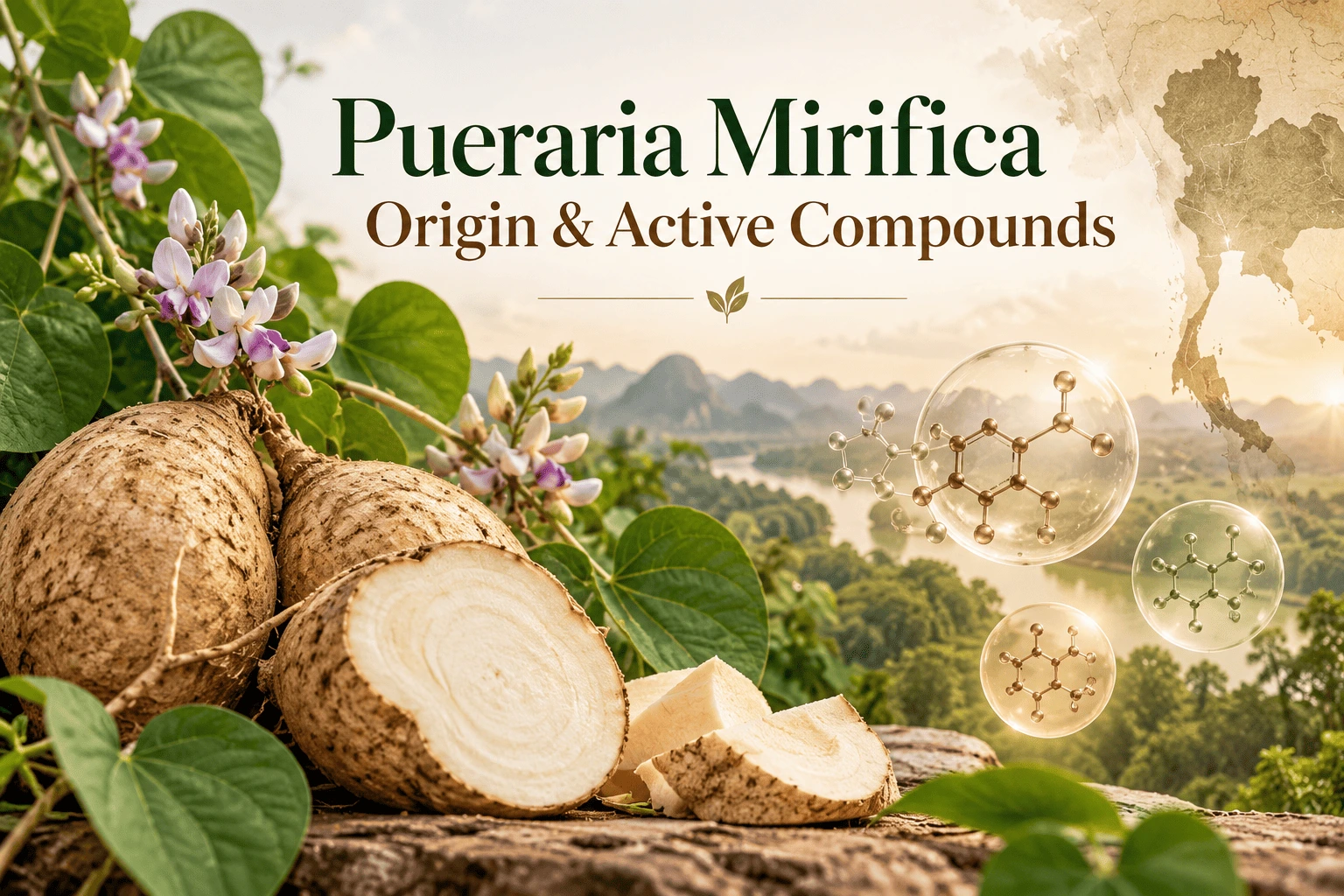
Pueraria candollei var. mirifica, known locally as White Kwao Krua, is native to mainland Southeast Asia, particularly Thailand and Myanmar. Thailand is its best-documented and most researched growing region, where it grows in upland areas.
Historically the plant was harvested from wild stands by local communities. As demand grew, cultivation expanded, and research has since been done on cultivars grown side by side in the same field. That shift from wild-harvested to farmed sourcing matters for quality and traceability, covered in quality & extraction.
Not the same plant as kudzu
One of the most common points of confusion is the relationship between Pueraria Mirifica and Pueraria montana var. lobata (kudzu), widely used in East Asian traditional medicine. The two are botanical relatives within the same genus, and both are sometimes called “kudzu” in English, but they are different plants and are not interchangeable as ingredients.
Genuine Pueraria Mirifica is more geographically restricted than kudzu, which is why species naming on a label is worth checking.
The active compounds in Pueraria Mirifica
A 2026 review counted 106 secondary metabolites identified in the root, including benzopyrans (the chromene group), isoflavones and their glycosides, and coumarins. Research points to a smaller set as the most biologically relevant. They fall into two groups.
- Group 01 · characteristic · Chromenes
- Benzopyran-type compounds that define Pueraria Mirifica and are its most potent phytoestrogens. Structurally distinct from typical isoflavones. Members: miroestrol · deoxymiroestrol.
- Group 02 · shared · Isoflavones
- A broader family shared with other legumes such as soy. Their levels in the root differ between cultivars and harvest seasons. Members: puerarin · daidzin · daidzein · genistin · genistein.
Early research first isolated miroestrol. Later work, using bioassay-guided purification, identified deoxymiroestrol as a potent phytoestrogen in the root, and found that deoxymiroestrol oxidizes readily in air into miroestrol. That suggests some of the miroestrol found in processed material may form after harvest rather than in the living root. Both compounds are used in the literature as markers for verifying that raw material is genuine Pueraria Mirifica.
How they are believed to act in the body
Laboratory and animal research describes these compounds as estrogenic, able to act on the body’s estrogen receptors. That activity is the proposed basis for the traditional and modern use of the root in skin, hair and general feminine wellness formulations, and for the more clinically studied use in menopausal comfort research.
Worth being precise: a plausible, laboratory-supported mechanism is not the same as a guaranteed outcome for every person or every claimed benefit. Individual response depends on dose, formulation, extraction quality and physiology, and a recent review notes that pharmacokinetic data and standardized dose-response relationships in humans are still lacking.
How scientists measure them today
Because miroestrol and deoxymiroestrol occur at low concentrations in the root, researchers have had to develop sensitive tools to measure them. HPLC methods have been established for quantifying miroestrol for standardization, and more recent work has developed an ELISA test that measures miroestrol and deoxymiroestrol together and correlates closely with HPLC.
This matters beyond the laboratory: the same testing methods used in academic research are, in principle, the ones a reputable manufacturer should be using to verify and standardize a commercial extract. When a brand references HPLC testing or a specific standardization level, it is drawing on the same analytical foundation as the published science.
Why this matters on a label
- Species accuracy matters: a product should specify Pueraria candollei var. mirifica, not simply “Pueraria” or “kudzu extract”.
- Standardization matters: raw material can be tested for miroestrol/deoxymiroestrol and total isoflavone content, and researchers argue that these levels should be specified.
- Origin matters: Thailand is the best-documented growing region, and compound levels vary by cultivar, so sourcing transparency is a reasonable thing to expect from a specialist brand.
Core Pueraria Care
Breast Capsules 60 capsules

Core Pueraria Care
Breast Cream 100 g
Key takeaways
- Native to Southeast Asia, particularly Thailand and Myanmar, and now widely cultivated.
- A different plant from kudzu (Pueraria lobata), despite belonging to the same genus.
- Its signature compounds, miroestrol and deoxymiroestrol, are chromenes that characterize this plant and are used as quality markers.
- It also contains common isoflavones (puerarin, daidzein, genistein) shared with soy and other legumes.
- These compounds are estrogenic in laboratory research, which is the proposed mechanism behind traditional and cosmetic use.
Frequently asked questions
What is the difference between miroestrol and deoxymiroestrol?
Both are potent phytoestrogens from the root. Deoxymiroestrol oxidizes readily in air into miroestrol, so some miroestrol in processed material may form after harvest. Both are used as markers of genuine Pueraria Mirifica.
Is Pueraria Mirifica the same as kudzu?
No. They belong to the same genus but are different plants. Kudzu (Pueraria lobata) is a separate ingredient and should not be sold as Pueraria Mirifica.
Why does origin matter for this ingredient?
Thailand is the best-documented and most researched growing region, and compound content varies meaningfully between cultivars and harvest seasons.
Are the active compounds regulated as drugs?
In cosmetic and supplement products, Pueraria Mirifica is generally handled as a botanical ingredient, not a drug, and products should not carry disease-treatment claims. Always check current local regulations in your market.
Sources
- Chansakaow S, et al. Identification of deoxymiroestrol as the actual rejuvenating principle of “Kwao Keur”, Pueraria mirifica. The known miroestrol may be an artifact. J Nat Prod. 2000;63(2):173–175. PubMed
- Cherdshewasart W, Sriwatcharakul S. Major isoflavonoid contents of the 1-year-cultivated phytoestrogen-rich herb, Pueraria mirifica. Biosci Biotechnol Biochem. 2007;71(10):2527–2533. PubMed
- Shimokawa S, et al. Quantitative analysis of miroestrol and kwakhurin for standardisation of Thai miracle herb “Kwao Keur” (Pueraria mirifica). Nat Prod Res. 2013;27(4-5):371–378. PubMed
- Yusakul G, et al. Enzyme linked immunosorbent assay for total potent estrogenic miroestrol and deoxymiroestrol of Pueraria candollei. J Nat Med. 2018;72(3):641–650. PubMed
- Zeng H, et al. Pueraria mirifica: a critical review of the ethnobotany, phytochemistry, pharmacology and challenges in standardization and safety. Front Pharmacol. 2026;17:1820644. PubMed
These statements have not been evaluated by the Food and Drug Administration. This product is not intended to diagnose, treat, cure or prevent any disease.
Herbal supplements are not a substitute for medical advice. Talk to a healthcare professional before use if you are pregnant, breastfeeding, taking medication or being treated for a medical condition.
Published by
Pueraria Mirifica™